
Need Waterproofing Help? Call: (860) 875-6646
The short answer: a properly done waterproofing job pays for itself faster than most homeowners expect. And it keeps paying by removing a problem that would otherwise come back every wet season for the life of the home.
The longer version involves understanding what water actually does to a foundation over time. Concrete is not impermeable. It absorbs moisture, releases it, and changes slightly with every cycle. Add Connecticut winters and the freeze-thaw that comes with them, and the small cracks that form from normal foundation settling grow wider season after season. What starts as something manageable becomes structural, quietly, over years.
We have been doing this work in Manchester and across Connecticut since 1976. You know, the homeowners who call us most often are not calling about their first wet floor. They are calling about their fourth or fifth, after years of a problem that never fully went away. That is the main reason to choose trusted waterproofing services in Manchester, CT. Getting it done the first time correctly is the long-term benefit. Here is what that looks like in practice.
Water moving through a foundation wall leaves evidence behind. The chalky white deposits that appear on basement walls, called efflorescence, are the mineral traces of moisture that has passed through the concrete repeatedly. They're not a cosmetic issue. They're a sign that something is moving through the wall it was never designed to accommodate, and that process is affecting the material itself over time.
In block foundations, mortar joints tend to soften and fail before the blocks themselves do. In poured concrete, shrinkage cracks that formed during curing open a little wider with each freeze-thaw cycle the ground goes through. Neither of these changes announces itself. They compound quietly. The wall cracks and seams we close with crack injection today cost a fraction of what those same cracks would require to address after another five seasons of water moving through them. That math holds across every basement we've worked in.
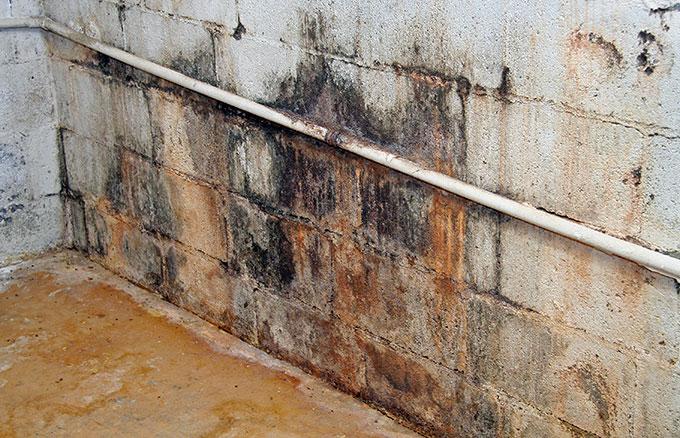
Most homeowners don't connect a damp basement to the air quality in the rooms where they actually spend time. The connection is real. Moisture that settles in concrete, in stored materials, in framing, and in insulation creates the conditions mold needs to get established. It doesn't take a visible puddle. Sustained humidity is enough, and a chronically wet basement provides it reliably.
Mold spores don't stay in the basement. They move through the house through normal air circulation. After a proper interior drainage system is in place, one that lowers the water table beneath the slab rather than just collecting water after it has already entered, the humidity in the space drops alongside the moisture source. Floor-level seepage stops. The conditions that support mold growth change. That improvement reaches the whole house, not just the lower level.
You Stop Spending Money on a Problem That Never Gets Fixed
There is a version of managing a wet basement that involves no permanent solution at all. A dehumidifier running from April through October. Towels placed in the same spots after every storm. A patch that holds through summer and fails the following spring. This approach has a recurring cost in both money and time, and the problem is exactly as present at year five as it was on day one.
What prevents that cycle is an accurate diagnosis before any repair is discussed. Jon Piela, our owner, personally evaluates every job. He holds a Connecticut P7 Plumber license and is a WRT-certified Water Remediation Technician, with over 30 years of hands-on experience in this region.
A wall leak through a poured concrete crack is not the same problem as floor-level seepage from hydrostatic pressure below the slab, and the repair is not the same either. Getting the cause right on the first visit is how a fix actually holds.
Connecticut home inspectors are thorough below grade. Efflorescence, staining, active cracks, and failed prior patches all end up in the inspection report, and all of it becomes a negotiating variable for the buyer. Sellers who address water intrusion before the inspection are in a materially different position than those who discover it at the table.
We've worked with many homeowners preparing a home for sale, and the pattern is consistent: resolving the problem before the listing is less disruptive and less expensive than being pressed to negotiate repairs as a condition of closing. When the work has been completed by a licensed contractor and is documented, it removes a question mark from the transaction rather than adding one.
This part is harder to calculate, but homeowners who've lived with a chronic water problem and then had it properly resolved tend to describe the change the same way. A basement that floods is not a storage space. It's a place where things get ruined, where nothing of value can safely sit on the floor, where every storm in the forecast becomes something to track with a particular kind of dread. That background stress is real, and it's the kind that people stop noticing only once it's gone.
Our crews average more than 12 years with us. We carry a 4.9-star rating across 118 verified Google reviews. The work is backed by a guarantee from a company that has operated continuously since 1976, run by the same family that started it. The long-term benefit of waterproofing is everything listed here, plus the confidence that we will still be there if you ever need us.
Homeowners in Manchester and across Connecticut ask us variations of these questions regularly. Here are direct answers to the ones that come up most.
What causes water to come in through the basement floor?
Water entering at floor level is typically caused by hydrostatic pressure, which is groundwater pushing up through the soil beneath the slab. It is not the same as a wall leak and requires a drainage solution installed below the floor, not a surface-level patch or an above-floor curb system.
How do I know the waterproofing work will hold long-term?
Our work is backed by a guarantee. More practically, we have operated continuously since 1976 and are a third-generation family business. The same family that installs the work will still be reachable if you ever need to follow up on it. That track record is not something a franchise or recently formed company can match.
How much does waterproofing or foundation repair cost in Connecticut?
Cost depends on the type of problem, the size of the area affected, and the repair method required. A single crack injection is far less expensive than a full interior drainage system. We provide free estimates based on what the home actually needs, with no standardized packages and no pricing driven by commission targets.
Do you offer free estimates?
Yes. We provide free estimates for all services. The owner evaluates every job personally.
We're here to assist you with all your waterproofing and drainage needs. Whether you're dealing with basement dampness, crumbling concrete, or window well leaks, our experienced team is ready to help.
Call Us: (860) 875-6646
Email Us:
Visit Us: Our office is located at 199 Adams St., Manchester, CT 06042
Business Hours: Monday to Friday, 8:00 AM - 4:00 PM
Online Form: For your convenience, you can also contact us via our online form.
At Eastern Waterproofing, we value your privacy. Rest assured, we do not sell or share your contact information with third parties.
Resources:
Related Topics: